22:39, Matthew says, "Love your neighbor as yourself."
Every December, in the week before the carol, a man knelt on the verandah of the corner house and went through the figures one by one. Joseph first, then Mary, then the shepherds, checking each for cracks, for chips at the edges, for places where the colour had gone dull or flaked away. He cleaned them and repainted where painting was needed, mixing the colour himself, matching what had been there before. When the figures were done he turned to the rest: the hanging baubles unwrapped from their newspaper, held to the light for damage, rehung on the same branches they had hung on the year before; the icicle ornaments counted and straightened; the LED string lights untangled and tested, each strand stretched between his hands before being tied back between the posts the way they had always been tied, the same loops, the same spacing. What had been packed away in March was restored in December to exactly what it had been.
He was Velan. His own father had washed the altar linen of Holy Family Church Bethlehem, the white cloth that covered the table of God, the embroidered Easter pieces that came out once a year like something woken from a long sleep. The grandfather returned them folded and without a wrinkle, the way you return something that was never really yours to keep but that you handled as if it were. Rajan Chettan did not wash clothes. He laid floors. He and his younger brother, in the spring of 2009, had laid the tiles in the nave of that same church. Cream and terracotta, alternating, sixteen inches square.
The old priest, Father Mathew, walked the finished floor and said, good work. Rajan Chettan nodded and packed his tools and went home with cement in the lines of his palms. He was the kind of man who measures twice before cutting once.
The crib had begun the year his son Ram was born. Moss from the rubber roots, a strip of blue cloth for the sky, three plaster figures from the shop near Vazhakulam junction. A small thing. A quiet thing. The waterfall came the following year, a pump borrowed from a cousin, water falling into a basin no bigger than a vessel of rice, and the sound it made on December nights was the sound of something that had no reason to be beautiful and was beautiful anyway.
Every year it grew. The cotton snow was pulled thin enough that the light bled through it. The stars were yellow bulbs hung low, low enough that you felt you could reach up and adjust them, the way you adjust something in your own home. People came from outside the ward to see it. From other wards, from the next junction. They stood in front of the corner house and did not speak immediately, which is what happens when something has been made with more care than the occasion required.
Ram was the first in the family to sit in a college classroom. He came out the other side a software engineer. He lived in the city on weekdays and came home on Fridays. His hands were clean in a way his father's never were and he felt the difference every time they sat at the same table, not with shame, but with the particular tenderness of a son who understands what was spent to make him possible.
Every year, in the weeks before Mandalam, the men of the family took the black mala around their necks. Forty-one days. No footwear on the red laterite roads. Simple food, which in that house meant the mother cooked without the things that make cooking interesting, and she did it without complaint because she understood that the vow her husband and sons carried was not a performance but a private conversation between a man and whatever he believed was listening.
The ward knew what the mala meant. The Christian families of Ward 6B, when they passed Rajan Chettan on the road in those forty-one days, spoke to him a little more gently, the way you speak to someone who is carrying something you cannot see.
At the end of it they climbed the eighteen steps at Sabarimala. They stood before Ayyappa in the cold of the hills and came home carrying the aravana payasam in small packets, the prasad cooked in the temple, jaggery and ghee and underneath those smells something else, something that was not a food smell, that came from the fact of what it had cost to bring it this far.
They gave it to the nearby houses. Not to every house. Not as a grand gesture. Mery Chechi next door. Thankachan Chettan across the lane. Two or three others. The giving took ten minutes. There was no ceremony in it. It was the way you share a mango from your own tree, because the tree gave more than one family needs and the neighbours are there and you love them in the ordinary daily way that does not require a reason.
Mery Chechi knew what she was holding. She knew the aravana payasam had come from Sabarimala, that it had been carried on the head of a man who had kept forty-one days of vow to receive it, that it belonged to Ayyappa the way the Eucharist on Sunday belonged to her. She received it in both hands. Both hands, the way you receive something that has cost someone something real.
She did not think this complicated her faith. She thought it deepened her life.
This exchange between two families had been happening for so many years that nobody in the ward had thought to call it harmony. It was not harmony. Harmony is what you call something when you are surprised it exists.
The carol committee came each December and stood in front of the corner house the way everyone else stood, without speaking immediately, and went away and came back the following year and stood there again. For seven years the prize, a Bible and a cake, went to the corner house. The Bible sat on the shelf where the family kept what mattered: the brass figure from the grandfather's time, Ram's engineering degree in its plastic cover, a photograph of the family at Sabarimala, the mala from the last pilgrimage hanging on a nail. The Bible sat among these things and did not look out of place, because in that house nothing that had been given with love was out of place.
Old Father Mathew had given the first Bible himself. He had placed it in Rajan Chettan's cement-rough hands and the father had received it the way Mery Chechi received the aravana payasam. In both hands. With the full knowledge of what was being passed between them.
In 2016 there was a new priest.
He was not a cruel man. He had a careful voice and a round face and he believed in order, and believing in order is not the same as cruelty but it can do the same things to a person that cruelty does. When the carol committee brought him the result for confirmation, he looked at the entry form. He looked up. He said, we cannot give a Church prize to a non-Christian family. And then, after a pause, in the voice of a man who has considered the matter fully and found it settled: this is not about the crib. It is about what the prize represents.
The prize went to another crib. The youth of the ward stood in front of it without speaking. It had no waterfall. The cotton snow sat in clumps. Joseph's robe was the original factory blue, the paint nobody had thought to touch up, because nobody had knelt on a verandah floor with a small brush in the evenings to keep it true.
Six of them went to the priest. They were young, which means they still believed that explaining a wrong thing to the person who had done it would make the person understand. The priest listened and explained and his explanation was the same as before and it did not change with their listening.
They collected money and went to Ram's house with a cake and the best words they could find. Ram's father sat in his chair. His hands were in his lap. The same hands that had measured and cut and laid every tile in the nave of that church. The hands that had carried the irumudi on his head for forty-one days and descended the eighteen steps holding what he had earned by that carrying. Those hands sat in his lap and he listened to the young people with their cake and their money and their words.
Ram accepted the cake from them. He set it on the table without a word.
His father said, no. He said it quietly. Without anger. Without tears.
The cake sat on the table. The young people left. The house was quiet.
The following December no lights came on at the corner house.
The carol team came on a Tuesday, the same night, the same road, the same stars over the rubber trees. They moved house to house. Here a star above a gate. Here a candle in a window. Here a nativity with factory paint, Joseph in his original blue, untouched.
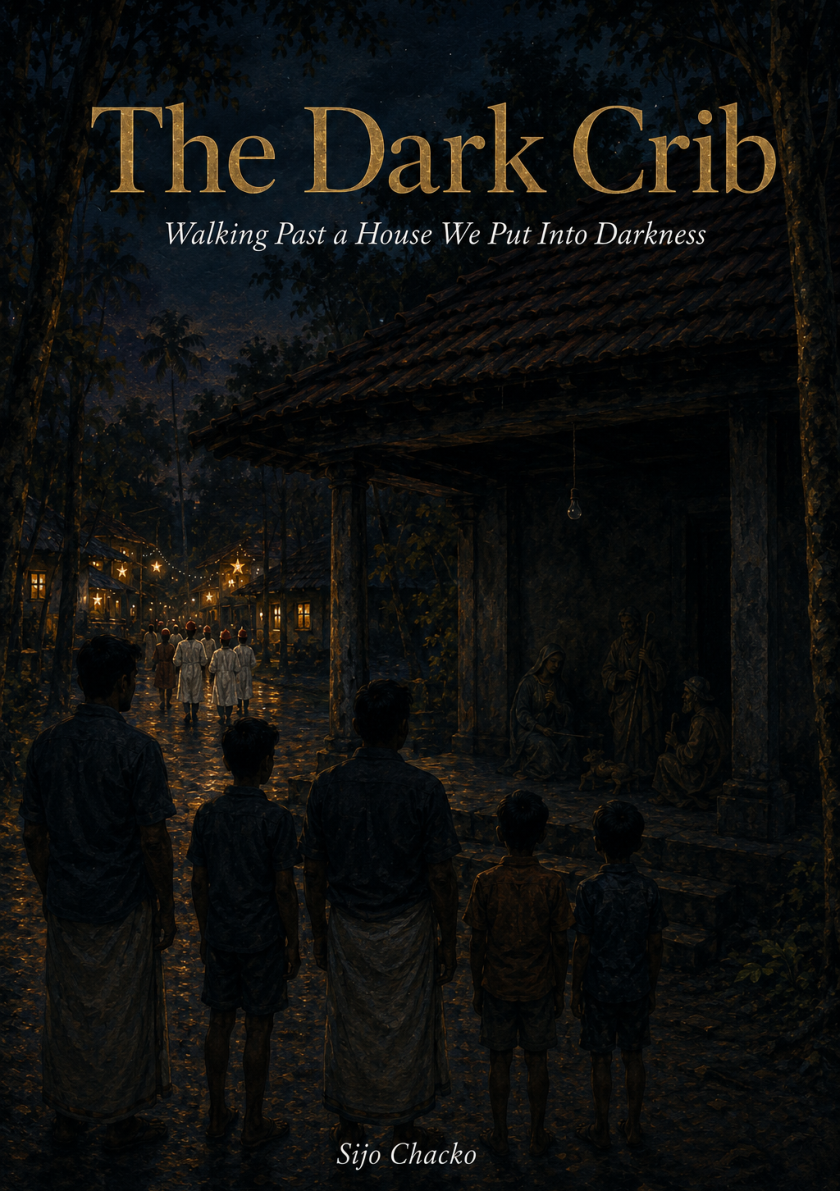
When they reached the corner where the road bent toward the estate, they saw them. Ram. His father. His uncle. The two younger cousins. Standing in front of the dark house. Not protesting. Not performing grief for the ward to witness. Simply standing, the way a family stands in front of something that has gone quiet, in the place where a sound used to be.
The waterfall was not running. The pump had been returned to the cousin three streets over the week before. No cotton snow. No low-hung stars. No Joseph with his carefully repainted robe. The verandah where the father had knelt with his small brush in the evenings was empty and dark.
The carol team passed. They sang what they were supposed to sing. The sound moved down the road.
Mery Chechi walked near the back of the group. When they reached the corner she stopped singing. She stopped because the sound left her. Because she was looking at Rajan Chettan standing in the dark in front of the house where, for seven Decembers, the waterfall had run through the night, and she was remembering the weight of the small packet in both her hands, the smell of jaggery and ghee and something underneath that was not a food smell, the way she had held it before she knew what to do with it, and then the way she had simply held it.
The carol moved on. The dark house stood.
Inside, on the shelf, the Bible from old Father Mathew still sat where it had always sat.
Rajan Chettan went inside after the carol passed. He sat at the table. The mala hung on the wall. The Bible sat on the shelf. The two things that two different houses of God had placed in his hands across a lifetime, sitting three feet apart in the lamplight, not in conflict, never in conflict, only in the quiet company of things that have been received with love and kept with care.
His wife brought him tea. He drank it.
And somewhere outside, where the waterfall used to run, there was only the sound of what had been lost, which is not silence, but the memory of water.
He saw her the evening after the carol. She was at the field's edge, the two cows beside her, the paddy stubble grey and flat in the late light. He had seen her at that field's edge every evening of his life without thinking about it, the way you stop seeing things that have always been there. She was a woman who smiled the way some people breathe, without deciding to.
He was passing on the road. She looked up and saw him. She nodded. She did not smile.
He walked on. He did not know what to do with his hands. He did not know what to do with what he had just seen, which was not grief exactly, and not anger, and not the face of a woman who had been defeated. It was something he had no word for, in Malayalam or any other language, the face of a woman who had spent her life with her hands open and had woken one morning to find that the world had a different understanding of what open hands were for.
The cows stood beside her. The field was quiet. He walked until the road bent and she was no longer visible and then he kept walking because there was nothing else to do.
The argument began the morning after the carol. It did not begin loudly. It began the way most true arguments begin in Kerala, sideways, through a comment that was not quite a comment, attached to a conversation about something else entirely.
Shaji's tea shop sat at the junction where the Kolchira road met the main road, a narrow room with four tables and a counter and a calendar on the wall that was two years old because nobody had bothered to replace it. Shaji himself was a small man who made strong tea and held opinions the way a good wall holds water, quietly and without leaking. He had been listening to the men of Ward 6B argue about crops, prices, politics, cricket, and each other's children for eleven years. He knew when an argument was finishing and when it was only pretending to finish. He refilled glasses and said nothing and heard everything.
The morning after the carol, Poulose came in first, the way he always did, and sat in the chair nearest the counter, the chair that was understood to be his without anyone having decided this. He was sixty-four, retired from the electricity board, and he had lived in Ward 6B since before the ward had its current boundaries.
He said, without looking up from his glass, the church made a mistake. That was all. He said it the way you state a fact about the weather.
Rahim came in ten minutes later, sat across from Poulose, accepted his tea from Shaji, and said, which mistake, there are several to choose from. Poulose told him. The crib. The prize. Ram's family. The new priest. Rahim was quiet for a moment. Then he said, I know. Everyone knows. What is there to say.
But the next morning Paulachan came, and Paulachan was not the kind of man who left things at statement and acknowledgment. He sat down and said the church has the right to decide who receives a church prize. A church prize is a church matter. The prize is the church's to give as the church sees fit.
Poulose said, they laid the floor of that church. Paulachan said, that is a different matter. Poulose said, is it.
Rahim put down his glass and said, if someone washes your father's sacred cloth for twenty years and lays the floor of your house and brings you prasad from the mountain every December and you tell them the prize cannot go to them, and then they stand in the dark while you walk past singing, what would you call that. Paulachan said, I would call it a complicated situation.
George Kutty came on the third morning. He was twenty-six and had been in the carol group that night and had not spoken about it since. He sat at the table near the wall and listened to Paulachan, who was still going.
George Kutty said, I was there that night. I was in the carol group. We walked past their house. They were standing outside in the dark, all of them, Ram and his father and his uncle, standing where the crib used to be. And we walked past. We sang. I sang. I knew every word of what I was singing and I sang it anyway and I walked past a family that had lit that corner of the ward for seven years and I did not stop.
Nobody said anything.
George Kutty said, we sang about a light that came into the darkness. We sang it walking past a house we had put into darkness. I want someone to explain to me how those two things belong in the same night.
The room was quiet. Outside, a motorcycle passed on the main road. Shaji picked up a glass and put it down again without washing it.
George Kutty said, I know it has reasons. I am asking if the reasons are good.
Nobody answered. The tea finished. One by one the men left. Paulachan last, adjusting his mundu at the door, not quite meeting anyone's eyes on the way out.
George Kutty sat for another minute after everyone had gone. Without looking up, he raised one finger. Another glass came without a word. He sat with the fresh tea in front of him, and the question he had asked still in the room, still unanswered, the way questions stay in a room long after the people arguing about them have gone home.
He drank the tea slowly. He paid and left.
Shaji wiped the counter. He straightened the calendar on the wall, the one that was two years old, and then left it as it was. Some things you straighten and they go crooked again and after a while you stop straightening them.
He made fresh tea for the next customer.
Copyright © 2026 Sijo Chacko. All rights reserved. This is a work of fiction.