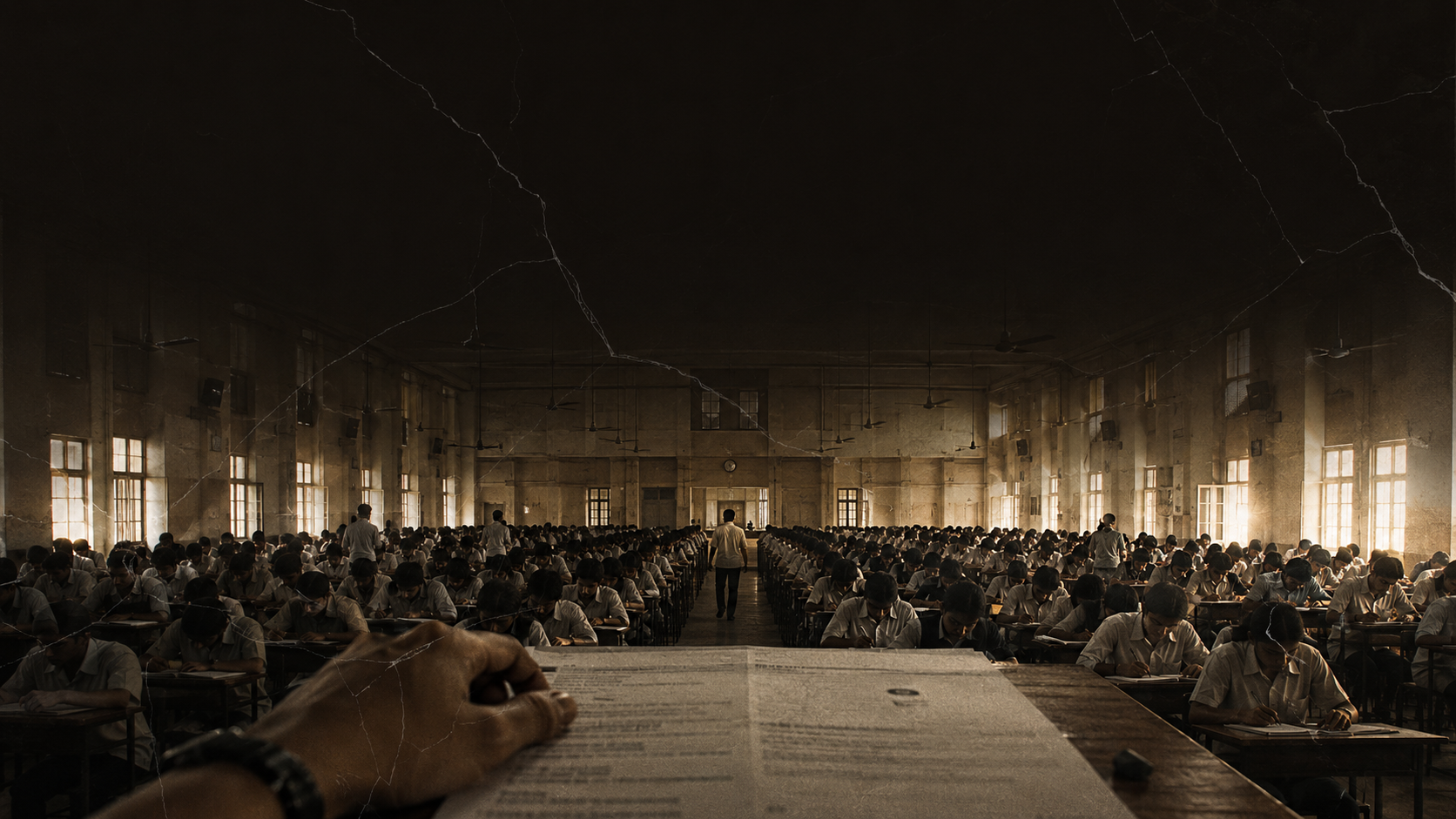
Every empire that rose did it the same way. Classrooms first, armies later. Every empire that fell did it the same way too. The classrooms cracked before the flags did.
The investor Ray Dalio reached a similar conclusion after studying the rise and fall of great powers, from the Dutch to the British to the Americans. Of all the strengths a nation can build, education comes first in time. Education feeds innovation. Innovation feeds trade and output. Trade and output feed armies and banks. Then, with a lag, comes the kind of power that names an era.
India knew this before anyone wrote it down. Takshashila was teaching students around the sixth century BCE. Nalanda rose in the fifth century CE and ran for seven hundred years; scholars crossed the Himalayas and the sea to sit in its classrooms. For a long stretch of history, if you wanted the finest education on earth, you travelled to India. The direction of travel has reversed. That is the whole story of decline, told in airline tickets.
The decline runs the same track everywhere. When a great power stops rising and starts coasting, the rich pull away from the poor, the debt grows, and the schools quietly rot. Nobody notices. The damage shows up in GDP figures years later, but it was done earlier, in exam halls, where the next generation was being prepared. Or wasn't.
"A country does not announce its own decline. It just stops producing the people who could have prevented it."
The Exam Hall as a Mirror of the Nation
An entrance exam makes one promise. A farmer's daughter and a minister's son sit the same paper, under the same fan, and whoever knows more wins. That is the whole promise. Break it and something larger breaks with it.
India's NEET-UG 2024 broke it in public. One exam, 2.4 million students, and the seats that decide who becomes a doctor. Question papers leaked before the exam in at least one state, sold through brokers for large sums. A handful of centers produced results that statistics could not explain, including several students who arrived at the exact same perfect score. Genius, it turns out, sits together. Grace marks appeared through a process nobody had explained in advance. Students who had prepared honestly stood on the road with placards demanding a fair exam. The Supreme Court heard the case for months. It found individual irregularities, but not a leak wide enough to cancel the exam. No re-test. The regulators denied systemic wrongdoing throughout.
That was 2024. In 2026 it happened again. Another NEET season, another leaked paper, fresh irregularities in board marking. This time the students did not wait to be defended. Since June, thousands have been sitting at Jantar Mantar in Delhi under a banner called the Cockroach Janta Party, a name they took from a senior judge's remark comparing unemployed youth to cockroaches. They picked up the insult and wore it as a uniform. A respected activist joined them on an indefinite hunger strike. In July, when they marched toward Parliament, they were met with tear gas, and a Union minister accused them of acting against the nation.
"The paper leaked. The students protested. The tear gas came for the students. Nobody has yet tear-gassed a broker."
I am not interested in which party said what. Blame is not the point. The machine is the point. When a country's flagship exam becomes something its own students no longer trust, the exam has stopped doing its one job.
The Oldest Trick in the Syllabus
Watch what the television debates discuss in the week an exam leaks. It will not be exam security. It will be religion. This is not the habit of one party. It is the habit of the trade, practiced across the aisle, perfected over decades. Every side has learned that a temple or a mosque can trend longer than a question paper, and that a voter angry about God forgets to be angry about NEET. Religion is the one subject that requires no preparation, has no syllabus, and can never be leaked. So it gets played, season after season, while the actual curriculum of a nation, schools, hospitals, jobs, waits outside the studio.
Faith deserves better employment than this. So do the faithful.
Why This Matters More Than It Looks Like It Does
It is tempting to file a leaked paper under scandal of the week. Look at it through the longer lens of history and it looks different. An exam is how a country finds out who its capable people are. Compromise it and the country loses some seats, yes. Worse, it loses information. Multiply that across a few million students a year, across decades, and you do not get a scandal. You get institutions staffed through the crack in the wall instead of the door.
The most damaged students are not in the headlines. They are the ones without thirty lakhs for a broker. They gave two years of their adolescence to coaching centers on a promise that work would be rewarded fairly. Now they must wonder. The doubt does its own teaching: that the system runs on money and connections, not merit. It teaches this at exactly the age when a capable eighteen-year-old is deciding whether to stay or go.
And they go. Not because they hate this country, but because they want working infrastructure, honest queues, and a living standard that does not depend on knowing someone. They will build all of that, brilliantly, for somebody else's country. The countries at Takshashila's gates have become the countries at the visa counter, and the line now runs the other way.
The leaders know this better than anyone. Watch where they go when their own bodies fail. The same leaders who praise our hospitals at inaugurations quietly fly abroad when their own hearts need repair, to America, to wherever the machines are newer. Nobody has ever been called anti-national at the boarding gate of a medical flight. Treatment abroad is apparently patriotism; a student asking for a fair exam is apparently sedition. The mathematics of this escapes me, and I was good at mathematics.
And before anyone reaches for that word: the girl who studied two years for a stolen exam and still stands at Jantar Mantar asking her country to work is not the anti-national. She could have booked the flight. She stayed to argue. The man who sold the paper, the official who looked away, the leader who changed the subject to religion, the word belongs to them. Criticizing a fever is not hatred of the patient. It is how you keep the patient alive.
What Quality Education Actually Requires
This is not an argument against exams, or against any country or institution. It is an argument that the integrity of the exam is part of the curriculum. A country can have excellent textbooks and excellent teachers and still fail its students completely if the paper can be bought. The strongest rising powers in history taught character and work ethic, and rewarded effective people on merit. A leaked paper teaches the opposite syllabus, and teaches it well, in one night, for fifty lakhs.
The fix, whatever form it takes, must answer one question. Can a leak, a suspicious score, an unexplained grace mark be caught before it changes a student's life, not after millions have already sat the test? A country that cannot yet say yes is not having a bad exam season. It is choosing the decade its decline begins in.
The land of Nalanda and Takshashila did not become great by accident, and it will not stay great by nostalgia. Empires fall exam by exam, classroom by classroom, one small uncorrected failure at a time, until one day the students are gone, the flights are full, and the gap is too wide to close.